Hi Class and Visitors,
The last 2 nights of warm weather brought the moths out. So below are a few highlight pics, plus my inputs to iNaturalist are all updated with the new moths.
Seeing nature come alive as Spring truly appears is so Great!!!
Bill


Hi Class and Visitors,
The last 2 nights of warm weather brought the moths out. So below are a few highlight pics, plus my inputs to iNaturalist are all updated with the new moths.
Seeing nature come alive as Spring truly appears is so Great!!!
Bill
Hello OLLI Class...and anyone else who happens upon this post,
After our last class I did some research on iNaturalist, and first off I think I found the best way to return to "Home" on the site. Regardless of where you are on the site, go to your icon pic in the upper right hand corner, click on it, and select "Dashboard". This takes you to your "Home" and from there you may wish to select "Your Observations" which will show you recent edits to your observations, such as confirmations. Often there are two tabs, "More" and "Show More". The "Show More" tab keeps you in the same function and just expands the pictures you can view. "More" seems to take you to a similar, but new window. Hey I am learning with you :)
Now concerning using a mobile phone, for iPhones, there are two iNaturalist apps. One is called "iNaturalist" and one is called "Seek". I down loaded and tried both and they are definitely the best way to use iNaturalist capabilities on an iPhone. They both tie into your phone's camera and connect with iNaturalist's main computers for identification of what you have photographed. The main difference between the 2 apps is that Seek does not download any data to iNaturalist, whereas the iNaturalist app can download pics and info to your iNaturalist account (if you have one, or it can help you get one).
For Androids, per Joan Mansperger, there is only "Seek", which has the camera connection and iNaturalist computer ID connection, BUT does NOT have capability to download data to an account. iNaturalist actually recommends Seek for new and novice users, so the inexperienced do not upload a bunch of low quality data and photos.
Lastly, in the menu bar at the very top there is an option labelled "More". This tab will take you to options such as "Getting Started" and "Video Tutorials", so you are basically never without HELP!
More on all of this in our upcoming class Wed, April 13, 2022.
I hope all well, and enjoying nature. Sally and I are seeing early migrant warblers, like Yellow-rumped, Parula, Black-and-White and Yellow-throated (below).

No more words needed other than this pic was taken on top of the Ethiopian plateau at 10,000+ ft. As you can for sure tell, the Ethiopian Wolf and I were communicating...he even offered to bring me a Mole Rat, his favorite food. Your quiz question is...."What was my reply?"

Hi Olli Class... and anyone else interested in this issue,
Here is how to quickly get to details on a species…..Just click on the
species name, either in English or Latin, in a window, and now seems to work in all windows. Not sure why this seemingly did not work
many times this morning…. other than maybe there was an iNat ghost in the room
today....😎 Do it right and here is what you get....but it does seen you have to copy and paste these links.
https://www.inaturalist.org/taxa/41566-Megaptera-novaeangliae
https://www.inaturalist.org/taxa/41724-Hydrurga-leptonyx
https://www.inaturalist.org/taxa/118513-Hypena-scabra

In this course we will do the following:
• Learn about iNaturalist as a user friendly record keeping program to track nature observations worldwide.
• Bill will review some of his over 1,000 entries, and show how the AI aspect of iNaturalist can be used to help identify a species from a photograph
• Class members will be encouraged to establish an iNaturalist account, photograph some specimens of their favorite wildlife (animals or plants), and upload the photos to their iNaturalist account.
• Class members should have a means of logging onto the Internet while at class. OLLI has some class-available Laptops & i-Pads.
• It is tentatively planned during the course to take at least one field trip to photograph wildlife. A cell phone camera will suffice for taking wildlife photos.
Want a preview of Bill's iNaturalist account, go here (probably have to copy and paste): https://www.inaturalist.org/observations/bill6711
I suspect in some ways..... mentally, physically, or both, we are all Wandering Albatrosses :)

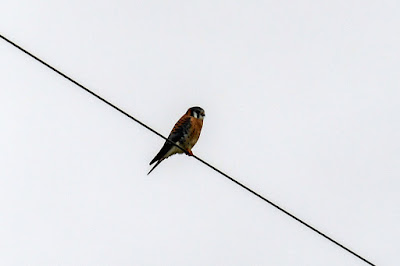
Lots of good birds with a good friend we had not seen in about 4 years, Curt Davis. We started at Fowler Beach and watched about 10,000 Snow Geese lift off between 8 and 9 am. In part of that was an incoming flock of 10 Tundra Swans, and 2 im. Bald Eagles. Then we moved on south for several great American Kestrel views. Our final highlight was Prime Hook Beach Road where we max'd out our Bald Eagle count at 8, and had many waterfowl, mostly Black Ducks, Mallards and Pintails. We concluded on the DE Bay seashore for some delightful close and trusting Sanderlings. Pics are below.

Unfortunately,
we also have one or more hawks hanging around terrorizing our feeder
birds. We have yet to see a hawk, but that is also the norm. The
feeder birds when a hawk is around either freeze, as the hawk looks for
movement to detect prey, or they bolt for cover and do not reappear,
often for an hour or more. The most likely hawks in our yard are either
Cooper's or Sharp-shinned Hawks, as their primary prey is other birds.